Heavy-Duty Weed Barrier Fabric: Install Tips for Gravel & Beds
Heavy Duty Weed Barrier Landscape Fabric for Cleaner Beds, Paths, and Hardscapes
A heavy duty weed barrier landscape fabric helps block sunlight from reaching weed seeds while still allowing water and air to move through the soil. When installed correctly under mulch, gravel, or pavers, it reduces ongoing weeding, keeps ground cover areas neater, and stabilizes loose materials on sloped or high-traffic spots.
What it does (and what it doesn’t)
- Blocks most weed growth by limiting light, especially for annual weeds that sprout from seed.
- Allows water drainage and soil airflow when properly overlapped and not sealed under impermeable layers.
- Helps separate soil from gravel to slow sinking, muddying, and stone migration.
- Does not permanently eliminate weeds—windblown seeds can still germinate on top of mulch, dust, or gravel.
- Not a substitute for edging; open seams and unpinned edges are common weed entry points.
Extension guidance often emphasizes that fabric performance depends heavily on the top layer and ongoing maintenance—especially preventing organic debris from turning the surface into a mini seedbed. For more background, see the University of Minnesota Extension overview of landscape fabric pros and cons and Washington State University Extension notes on mulches.
Best places to use heavy duty fabric
- Gravel driveways, parking pads, and utility areas where stone needs separation from soil.
- Garden paths and stepping-stone walkways to reduce mud and keep surfaces level.
- Under decks, sheds, and play areas where low-maintenance ground coverage is preferred.
- Shrub beds and perennial borders where plants are already established and spacing is stable.
- Slopes and drainage swales where fabric can reduce erosion when paired with rock or mulch.
Where other solutions may work better
- Vegetable gardens: frequent planting and soil amending can make fabric inconvenient; consider compost + mulch or kraft paper layers.
- Annual flower beds: regular replanting often tears fabric and creates openings.
- Areas with aggressive spreading plants (some groundcovers): runners can tangle with fabric and complicate maintenance.
- Places prone to heavy silt buildup: fine sediment can clog fabric over time; periodic top-layer refresh helps.
Material types and how to pick the right weight
- Woven polypropylene: strong and tear-resistant; commonly used under gravel and hardscapes.
- Non-woven (spunbond): typically better for drainage and filtration; often used for drainage projects and under decorative stone when specified for that use.
- Perforated plastic films: block weeds but can trap water and reduce oxygen exchange; generally less ideal for plant beds.
- Match weight to abuse level: heavier fabrics resist punctures from angular rock and foot traffic; lighter fabrics cut more easily around plants but may fail sooner under stone.
Quick guide to matching fabric to the job
| Project | Priority | Suggested fabric approach | Top layer notes |
|---|---|---|---|
| Gravel driveway or parking area | Separation + durability | Heavy-duty woven landscape fabric | Use 2–4 in. compacted base + 2–3 in. gravel; overlap seams generously |
| Garden path with mulch | Weed reduction + easy refresh | Medium-to-heavy landscape fabric | Maintain 2–3 in. mulch; remove debris so seeds don’t build a topsoil layer |
| Shrub bed | Low maintenance | Medium-to-heavy fabric cut around shrubs | Keep fabric covered to protect from UV; topdress mulch annually |
| Under pavers | Stability | Fabric used as separator where specified (or geotextile per base design) | Follow local base depth guidance; compact in lifts |
Installation steps that make it last
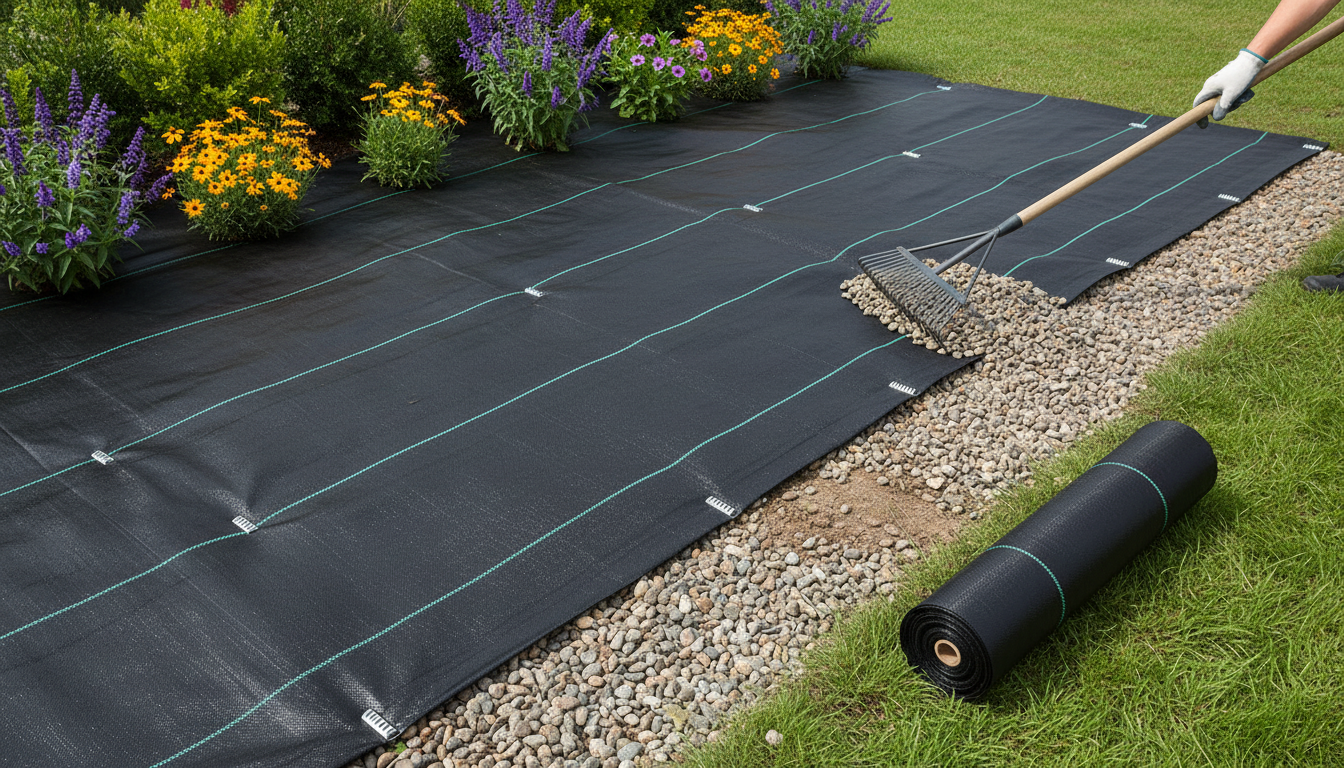
- Clear and level: remove existing weeds, roots, and sharp stones; rake to a smooth grade to prevent punctures.
- Optional pre-treatment: for established weeds, remove crowns and roots; avoid relying on fabric to smother mature perennials.
- Lay fabric with overlap: overlap adjacent runs 6–12 inches; place overlaps downhill on slopes when possible.
- Anchor securely: use landscape staples/pins every 12–24 inches, and closer on edges, curves, and slopes.
- Cut clean planting holes: make X-cuts just large enough for the plant; tuck flaps under and add mulch to cover openings.
- Cover immediately: apply mulch or stone the same day to protect from UV exposure and wind lift.
- Edge control: add edging or trench edges 2–3 inches deep to keep weeds from creeping under the perimeter.
Sizing, overlap, and estimating how much to buy
Using fabric with mulch, gravel, or stone
Common mistakes that lead to weeds anyway
Care and upkeep for long-term results
Product spotlight: Heavy Duty Weed Barrier Landscape Fabric
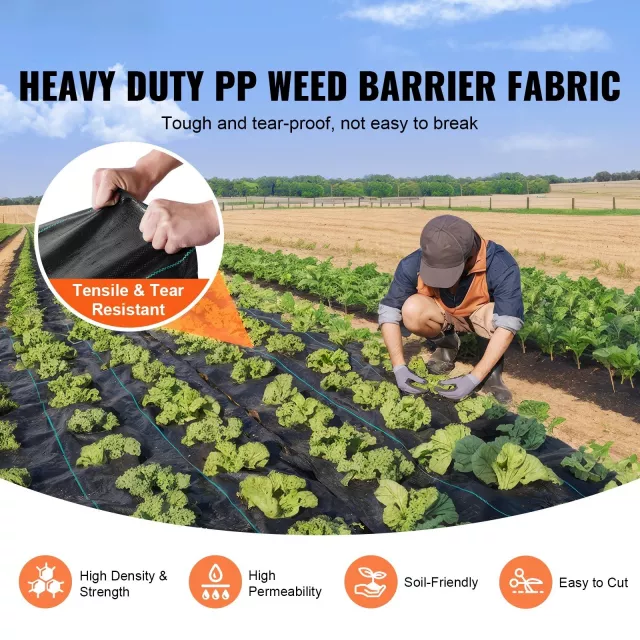
For projects where the barrier also needs to handle foot traffic, angular rock, or frequent edging work, Heavy Duty Weed Barrier Landscape Fabric is built for demanding outdoor use under gravel, stone, and hardscapes. Pair it with plenty of staples/pins, overlap seams generously, and keep it consistently covered with mulch or gravel to protect it from UV exposure and wind lift.
If you’re setting up a longer install day, a compact carry-all can help keep gloves, a utility knife, and extra pins from disappearing into the yard. The Waterproof Multifunctional 1.5L Bike Frame & Saddle Storage Bag can double as a small organizer for lightweight tools and supplies while you move between beds and paths.
FAQ
Should landscape fabric go under mulch or under soil?
Place landscape fabric on top of prepared soil, then cover it with mulch or stone. Burying it under soil reduces its ability to block light and can create a frustrating layer when you dig later.
How much overlap is needed between rolls?
Use 6–12 inches of overlap for most projects. Increase overlap in high-traffic areas, on slopes, or under gravel where shifting and seam separation are more likely.
Will weeds grow through heavy duty fabric?
Most weeds won’t push through intact, properly pinned fabric. The common issue is weeds sprouting on top as windblown debris turns into a thin soil layer, especially at seams, edges, and oversized planting holes.





Leave a comment